


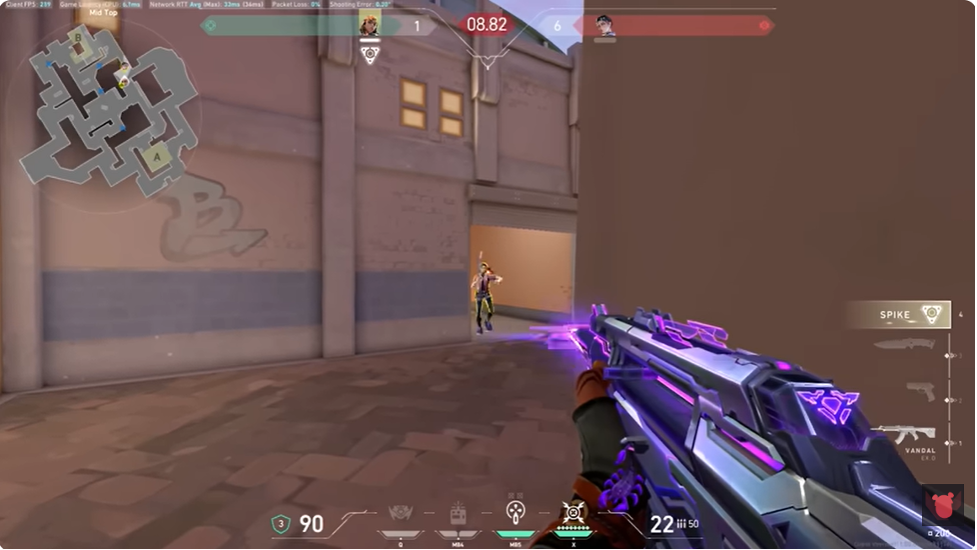
Here’s something most Valorant players get wrong: they think aim training is about flicking to heads.
It’s not.
Real aim improvement comes from never needing to flick in the first place. That’s crosshair placement—the difference between Radiant players with 90% headshot rates and everyone else stuck in ranked hell.
The best part? Unlike raw reaction time or muscle memory from hours of aim training, crosshair placement is a skill you can master through understanding a few core concepts. This guide breaks down exactly how pros like Demon1 hold angles without moving their mouse.
Why Crosshair Placement Beats Flicking
Think about how most gunfights actually happen in Valorant. You’re holding an angle. An enemy peeks. The player who shoots first usually wins.
If your crosshair is already at head height on the corner they’re about to peek, you just click. That’s a 200ms reaction. But if your crosshair is at chest level or aimed at the ground, you need to react AND correct your aim. That’s 500ms minimum for most players—and you’re already dead.
The math is simple. Pre-aiming eliminates the correction step entirely.
This is why radiant players can seemingly “predict” where enemies are. They’re not psychic—they’ve just positioned their crosshair where heads will be before anyone peeks. When you watch someone like TenZ hold an angle, notice how little his crosshair actually moves during firefights.
The Head Height Rule (And How to Actually Find It)
Everyone says “keep your crosshair at head level,” but that advice is useless without knowing where head level actually is on each map.
Here’s the practical approach: use map landmarks as reference points.
On Ascent, the bottom edge of wall lines marks head height. See that metal box on B site? Top edge equals standing head level. The generator at mid? Align your crosshair with its midline. These visual anchors become automatic after a few games, and suddenly you’re not guessing anymore.
Different maps have different markers. Bind uses the horizontal lines on walls. Haven has those distinct metal panels. The trick is spending five minutes in a custom game on each map, walking through common angles and noting what objects align with head height.
Elevation changes everything, though. When you’re on high ground looking down, heads appear lower relative to those landmarks. When pushing up ramps, enemies above you will have heads higher than your usual reference points. This is where most players mess up—they memorize one head height and apply it everywhere.
Distance Changes Your Positioning
Standing right next to a corner versus holding from ten meters back requires completely different crosshair positions.
Close to corners, hold your crosshair wider (farther from the wall). Why? Because enemies moving across your screen cover more distance relative to your position. They appear to move faster. You need that extra space to track and shoot.
From far away, hold tighter to walls. Enemy movement appears slower at distance, so you can position your crosshair almost on the corner edge. This also reduces the angles you’re exposed to.
The general rule: your crosshair distance from a corner should scale with YOUR distance from that corner. Get this wrong and you’re either aiming at empty space or scrambling to catch up to fast peeks.
Practice Routines That Actually Transfer to Games
Deathmatch is where theory meets reality, but most players practice wrong. They run around flicking to targets. That trains the wrong skill.
Instead, try this: load into deathmatch and restrict yourself to ZERO vertical crosshair movement. None. Your mouse can only move horizontally. This forces you to pre-aim head height and hold it there.
Sounds impossible? That’s the point. You’ll die a lot at first. But after twenty minutes, you start recognizing patterns. You learn which boxes, which wall edges, which visual markers keep you at head level on each part of the map. Now that skill transfers directly to competitive matches.
For players serious about improvement, structured practice makes a huge difference. Some use custom playlists or tools like THE GUIDE’s Insight for analytics, while others explore options like Valorant cheats with aimbot from Battlelog to understand how perfect crosshair placement looks mechanically—though obviously, competitive integrity means sticking to legitimate practice methods.
The Angle Merging Technique
Here’s an advanced concept that separates good crosshair placement from great: you can position your crosshair to cover multiple angles simultaneously.
Example: on Bind, when holding bottom mid from hookah, you can align your crosshair where the bottom mid wall meets the close elbow angle. From that single position, you’re covering top mid, the wall, and elbow. Three angles with one crosshair position.
Finding these merge points requires experimentation. Walk through sites in custom games, find two or three common enemy positions, then locate the crosshair position that lets you react to all of them with minimal adjustment. Pros do this instinctively after thousands of hours, but you can shortcut the learning curve by deliberately practicing it.
Weapon-Specific Crosshair Placement
The Vandal and Phantom are forgiving. Chest shots still kill relatively fast. You can be slightly off on your crosshair placement and still win duels.
The Guardian? Zero forgiveness. Body shots are weak. You either hit heads or you lose. This makes the Guardian the best training weapon for forced perfection in crosshair placement.
Spending a few deathmatch sessions with Guardian-only creates an interesting effect: when you switch back to rifles, your crosshair placement has unconsciously improved. You’re already positioned for headshots because the Guardian punished you every time you weren’t.
Common Mistakes Even Experienced Players Make
Holding crosshair in the center of angles instead of edges. This seems safer—you can react to peeks from either side. But it’s actually slower because you’re not committed to either angle, meaning you have to correct your aim regardless of which side they peek from.
Better approach: pick the most likely angle, commit your crosshair to that edge, and trust your reaction time for the less likely angle. Demon1’s technique involves holding right on corner edges and smoke boundaries. He’s committed, and it shows in his first-bullet accuracy.
Another mistake: not adjusting for enemy economy. When opponents are on eco, they might rush or take unusual angles. Your standard crosshair positions might be too passive. On gun rounds, players play more default positions—that’s when your practiced crosshair placement really shines.
The Peek Disruption Strategy
Sometimes the best crosshair placement is combined with movement to pull enemies off their positions.
Jiggle peeking or jump peeking forces defenders to adjust their crosshair to track you. Then you wide-swing into where their crosshair WAS positioned (before they adjusted). This works because most players over-correct, and you’re exploiting that predictable movement.
This concept—visualizing where enemy crosshairs are positioned and playing around them—flips crosshair placement from a defensive skill to an offensive weapon.
Making It Stick Through Deliberate Repetition
Knowledge without practice is just trivia. The players who actually improve their crosshair placement are the ones who deliberately practice these concepts until they become unconscious habits.
That means loading into custom games before ranked sessions. Walking through sites. Finding your landmarks. Drilling the elevation adjustments. Then taking those exact positions into real matches and noting what works.
The timeline for building muscle memory varies, but consistent daily practice over two weeks usually shows noticeable improvement. After a month, you’ll find yourself naturally pre-aiming common positions without thinking about it. That’s when crosshair placement transforms from a technique into a fundamental part of how you play Valorant.
The difference between players stuck in gold and those climbing to immortal often comes down to these fundamentals. Not flashy plays. Not insane flicks. Just consistently putting your crosshair where heads will be, before those heads appear.
That’s the skill worth training.